What are Diffusion Models?
This post is an excerpt adapted from Lilian Weng’s “What are Diffusion Models?” (July 2021), quoted here with attribution to test this blog’s math, figure, and code rendering. Read the full original for the complete treatment.
So far, there are three types of generative models that have shown great success in generating high-quality samples: GAN, VAE, and Flow-based models. Each has limitations of its own — GAN models are known for potentially unstable training, VAE relies on a surrogate loss, and Flow models have to use specialized architectures to construct reversible transforms.
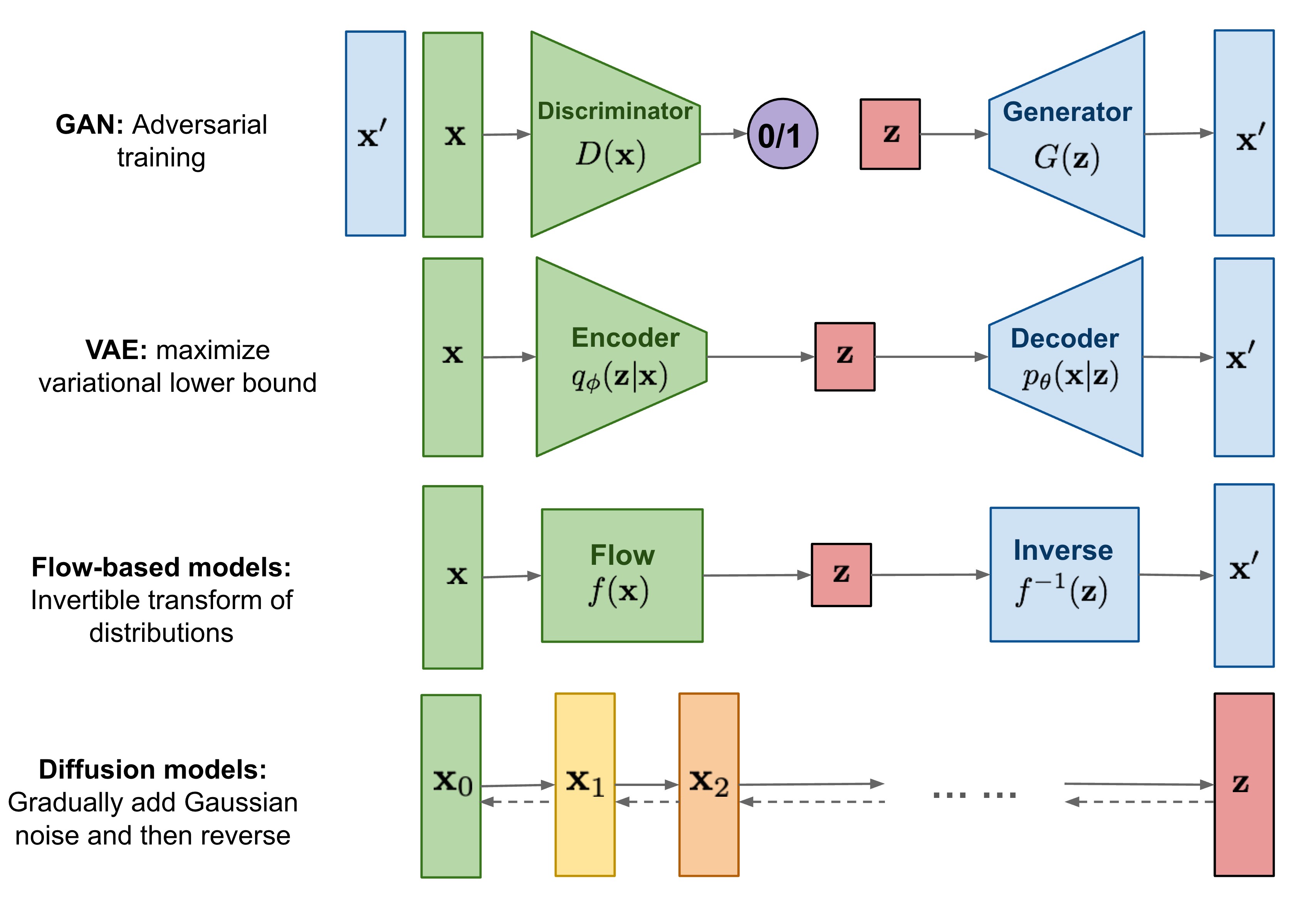
Diffusion models are inspired by non-equilibrium thermodynamics. They define a Markov chain of diffusion steps to slowly add random noise to data, then learn to reverse the diffusion process to construct desired data samples from the noise.
Given a data point sampled from a real data distribution , the forward diffusion process adds small amounts of Gaussian noise over steps:
Here’s an uncaptioned illustration straight from the source, embedded via plain Markdown image syntax rather than the figure include:
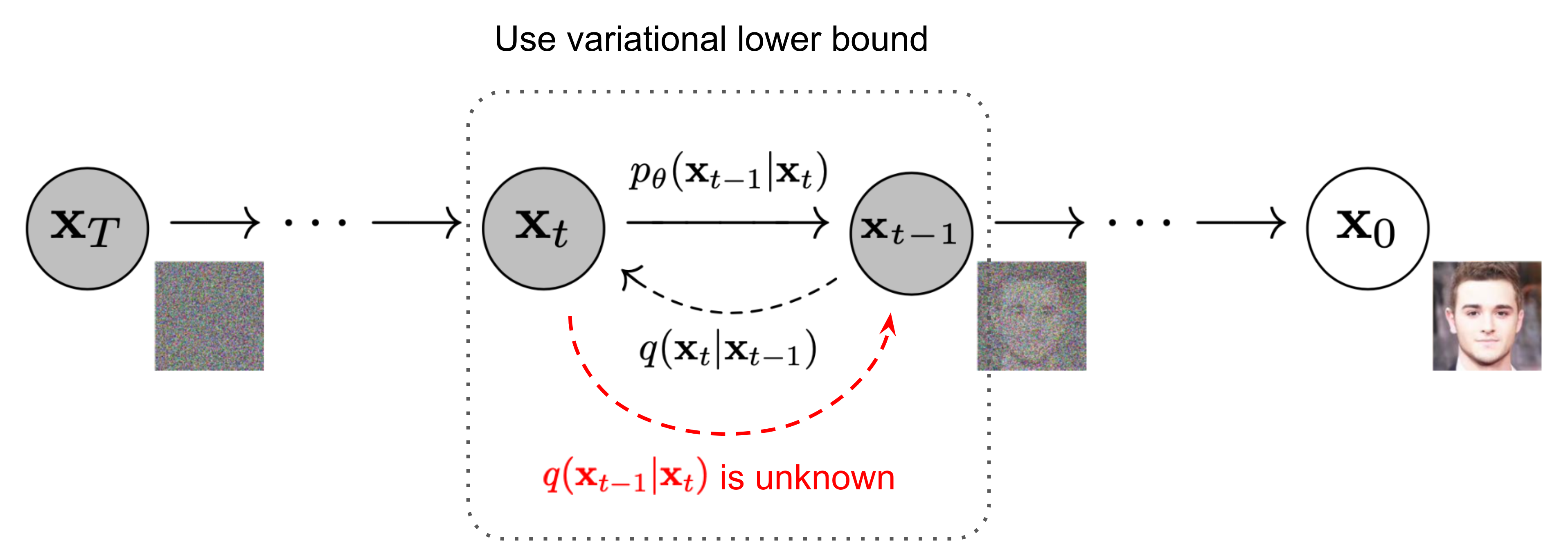
Visualizing the process
graph LR
  X0["x_0 (data)"] -->|+noise| X1["x_1"]
  X1 -->|+noise| Xdots["..."]
  Xdots -->|+noise| XT["x_T (noise)"]
  XT -->|denoise| Xdots2["..."]
  Xdots2 -->|denoise| X1b["x_1"]
  X1b -->|denoise| X0b["x_0 (reconstructed)"]
A minimal sampling loop
A rough sketch of the reverse sampling loop (not the real DDPM implementation, just illustrative):
import torch

def sample(model, shape, num_steps: int) -> torch.Tensor:
    x = torch.randn(shape)  # start from pure noise
    for t in reversed(range(num_steps)):
        noise_pred = model(x, t)
        x = denoise_step(x, noise_pred, t)
    return x
Setting up an environment to run it
python -m venv .venv
source .venv/bin/activate
pip install torch numpy
python sample.py --num-steps 1000 --output out.png
A tiny visualization stub
function plotNoiseSchedule(betas) {
  return betas.map((beta, t) => ({ t, beta }));
}
Cited as:
Weng, Lilian. (Jul 2021). What are diffusion models? Lil’Log. https://lilianweng.github.io/posts/2021-07-11-diffusion-models/.